West Virginia Deserves a Better Alternative to Another Electric Rate Hike
Under West Virginia Code §24-1-1(b), the Public Service Commission (PSC) is charged with balancing the interests of utility customers, the state’s economy, and the utilities it regulates. That responsibility is especially important because electric utilities operate as regulated monopolies. Unlike businesses in a competitive market, customers cannot simply choose another provider when prices rise.
That reality makes the current rate case (Case No. 26-0508-E-42T ) filed by Monongahela Power Company (Mon Power) and The Potomac Edison Company (Potomac Edison) worthy of close scrutiny.
Another Major Increase Proposed
On May 15, 2026, Mon Power and Potomac Edison filed revised tariff sheets seeking approximately $188.4 million in increased electric rates and charges. According to the filing, the proposal would increase total revenues by 10.6% during the first year.
For a typical residential customer using 1,000 kWh per month, the companies estimate the proposal would increase monthly bills from $137.86 to $155.75, an increase of $17.89 per month, or roughly 13%.
The companies also proposed an alternative “Adjustment Approach” that would spread increases over multiple years. Under that scenario, the combined increase would be approximately $75.6 million, or 4.25%, if approved through an expedited process.
On May 21, 2026, the PSC suspended the requested increase until March 2027 and scheduled evidentiary hearings for July 2026. The suspension ensures the proposal will receive further review before any new rates take effect.
A System Designed Around Guaranteed Returns
The current debate cannot be separated from the way utility regulation works.
On March 26, 2024, the PSC approved a settlement in Case No. 23-0460-E-42T that authorized Mon Power and Potomac Edison to earn a 9.8% Return on Equity (ROE).
ROE represents the profit a utility is permitted to earn on shareholder-funded investments. Regulators use ROE to attract capital and maintain reliable service. However, unlike competitive businesses, regulated utilities recover approved costs from customers and operate with exclusive service territories.
As a result, utilities face significantly less financial risk than most private businesses.
The 2024 settlement also established a three-year Infrastructure Investment Program pilot. Under the agreement, the companies were authorized to spend between $5 million and $10 million annually on approved projects and later seek recovery of those expenditures during future base rate proceedings.
While infrastructure investment is necessary, cost recovery mechanisms can create incentives that differ from those found in competitive markets. When approved expenditures are recoverable from ratepayers, utilities have strong incentives to continue expanding capital investment programs.
The result is a recurring cycle: infrastructure spending, cost recovery requests, and rate increases.
The Burden Falls on Ratepayers
Supporters of the increase may argue that a $150 monthly electric bill represents only about 3% of West Virginia’s 2024 median household income of $59,608. However, median figures often hide economic realities.
According to Census Bureau data, West Virginia’s poverty rate remains 16.7%, among the highest in the nation. Many households live paycheck to paycheck, and nearly half of West Virginia households fall below the ALICE threshold, meaning they struggle to afford basic necessities despite being employed.
For lower-income households, utility bills consume a much larger share of monthly income than statewide averages suggest. A family supported by two minimum wage earners could see an electric bill consume nearly 5% of monthly income before accounting for housing, transportation, food, healthcare, and other necessities.
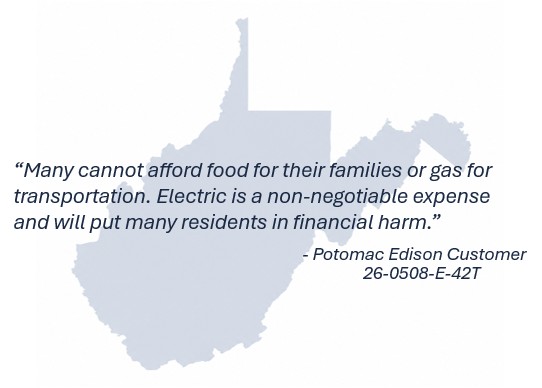
For these households every dollar matters. This isn’t just another rate increase; it’s another decision on what meal to cut or which medication to skip.
Protected From Losses
West Virginia has long recognized the need to assist vulnerable households with utility costs.
Under WV Code §24‑2A‑1, eligible low-income customers may receive reduced electric and natural gas rates for the billing months of December, January, February, March and April of each year. Importantly, the law allows participating utilities to recover those revenue deficiencies through state tax credits.
This structure helps protect low-income customers while also ensuring utilities do not absorb the financial impact of the discounts. In other words, even programs designed to reduce customer bills are often structured to shield utilities from losses.
FirstEnergy’s Financial Position
Mon Power and Potomac Edison are by no means struggling to remain solvent. In 2025, Mon Power reported approximately $246.6 million in net operating income from West Virginia operations, while Potomac Edison reported approximately $49 million.
Both companies are wholly owned subsidiaries of FirstEnergy which reported approximately $1.02 billion in net income in 2025, up from roughly $978 million in 2024. These figures do not suggest a utility system in financial distress. They suggest a regulated enterprise that is already generating substantial returns.
West Virginia’s ROE Stands Out
West Virginia’s authorized ROE remains high relative to the state’s economic conditions. FirstEnergy’s 2025 Annual Report shows West Virginia’s electric operations authorized to earn a 9.8% ROE, while Maryland and New Jersey employ separate authorized returns for distribution and transmission assets.
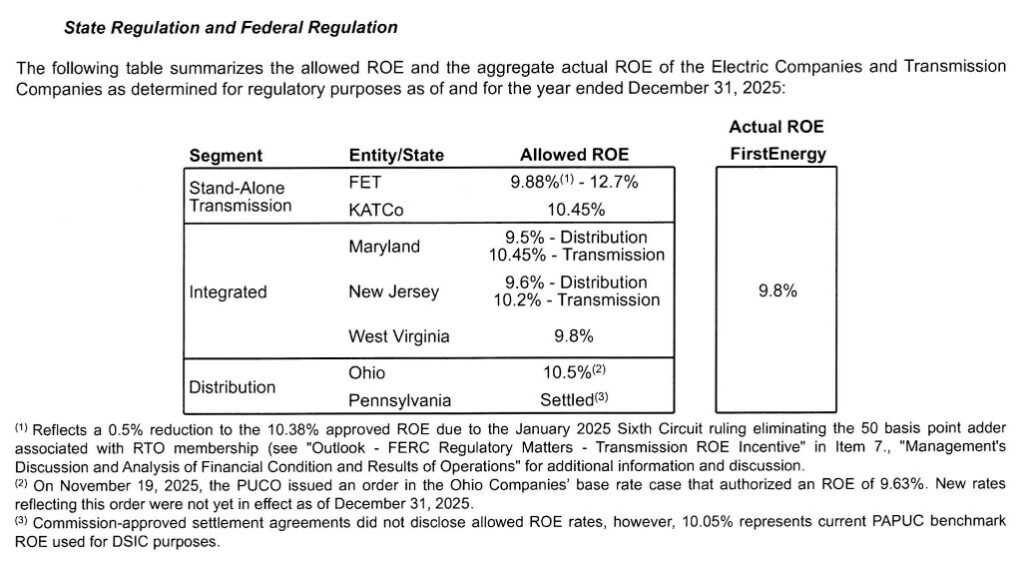
The distinction is important because transmission and distribution systems serve different purposes and carry different investment characteristics. Transmission projects are typically larger in scale, serve regional markets, and are often subject to distinct regulatory treatment. Distribution assets, by contrast, primarily serve local customers through poles, wires, substations, and neighborhood infrastructure.
Despite these differences, West Virginia continues to apply a blended 9.8% ROE across both asset classes. Maryland and New Jersey have already adopted frameworks that recognize the differing risks and functions of transmission and distribution investments through separate return structures.
The comparison is particularly striking given West Virginia’s economic realities. The state has lower median household incomes and higher poverty rates than either Maryland or New Jersey. Yet West Virginia ratepayers continue to support an authorized return structure that is not only comparable to those states, but also less tailored to the underlying characteristics of the assets being regulated.
A Path Toward Structural Reform
If the PSC is unable to reduce the frequency of rate hikes and maintain affordable bills for West Virginia families, it should consider structural reform by separating the authorized returns for distribution and transmission assets.
Because transmission infrastructure serves regional and interstate functions, those large-scale investments generally attract significant capital and often justify distinct returns. Conversely, local distribution systems primarily serve captive local customers who have no ability to shop for alternative providers.
Under a split-rate approach, the PSC could maintain a competitive market return for transmission investments while reducing the allowed ROE on local distribution assets. Such a structure would better align utility profits with actual investment risk, reduce the financial burden placed on West Virginia households, and bring the state’s regulatory framework closer to the modern approaches already used elsewhere within FirstEnergy’s service territory.
Household Income, Poverty, and Minimum Wage Comparison
| State | Median Household Income | Population Below Poverty % | Income Rank | Poverty Rank | Current Minimum Wage |
|---|---|---|---|---|---|
| Maryland | $102,900 | 9.6% | #4 | #48 | $15.00 / hr |
| New Jersey | $104,300 | 9.7% | #3 | #47 | $15.49 / hr |
| West Virginia | $60,800 | 16.8% | #49 | #4 | $8.75 / hr |
| United States | $81,600 | 12.3% | — | — | $7.25 / hr (Fed) |
The PSC’s Responsibility
The question before the PSC is not whether utilities should earn a profit. Reliable electric service requires investment, maintenance, and access to capital. The question is whether West Virginia consumers should (or can) continue paying rates that support near double-digit returns while many households struggle to afford basic necessities.
State law requires the PSC to balance the interests of utilities with the interests of customers and the broader economy.
As this rate case moves forward, regulators should look beyond the requested revenue increase and examine the underlying structure that drives repeated rate hikes and the long term sustainability of increasing rates on West Virginia families.