
Navigating the Complexity of the Weirton Area Water Board (WAWB)
When a catastrophic main line break depleted Weirton’s water system in late 2024, residents were plunged into a three-month crisis of total outages, painfully low pressure, and tap water that ran in disturbing shades of yellow and brown.
The immediate culprit was a failure that rapidly depleted the city’s water reserves, a blow that the fragile network was unable to survive. While the decay of aging cast iron and galvanized pipes provided the backdrop, the subsequent investigation identified a deeper structural liability: an astonishing 40 percent of the city’s water lines were installed above the frost line. This violation of state requirements essentially ensured that a standard winter freeze could trigger a systemic collapse. As the physical infrastructure failed, a second, equally critical vulnerability was laid bare.
The crisis exposed a municipal governance structure that is dizzyingly complex, difficult for the public to interpret, and fundamentally raises the question: is the system actually designed to work for the people?
A System Under Stress
The infrastructure failure triggered intervention by the Public Service Commission (PSC) after West Virginia House of Delegates Majority Leader Pat McGeehan requested a formal investigation. The Public Service Commission issued a series of orders on July 25, 2025 requiring the development of comprehensive corrective plans, including infrastructure replacement, leak detection, water loss reduction, compliance with public health standards, and improvements to customer communication systems. The Weirton Area Water Board (WAWB) submitted its response on October 22, 2025. In December 2025, the Commission ordered full implementation of those plans, along with mandatory quarterly status reporting to track progress, identify obstacles, and document ongoing work.
As frustrations mounted public scrutiny shifted from the broken pipes to the boardroom. Residents demanded to know who held the authority to fix the mess, and more importantly, who was accountable for letting it happen. The answers provided by the city’s organizational framework are anything but clear.
The Illusion of Autonomy
Weirton’s utilities are managed by two distinct entities:
- The Weirton Sanitary Board (WSB), established in 1956, oversees wastewater treatment. Its three member structure includes the Mayor as Chairman, a professional engineer, and a city resident.
- The WAWB, established in 1955, manages the public water system. It consists of five members who must be West Virginia residents and customers of the system.
In June 2001, City Council passed Ordinance 1317, transferring the management of the water system to the WAWB to theoretically streamline operations and reduce purchasing delays. Minutes from April 17, 2001 show City Council expressed concerns about ‘losing control’ to the WAWB prior to the June approval.
Utilities Director Butch Mastrantoni addressed the Council stating, “it’s not true; it would still be responsive to council with its concerns or requests.” He further noted Council would still control the Board’s membership, rate-setting, and the existence of the WAWB.
Today, the WAWB is frequently described—even on the City of Weirton’s own website—as “autonomous.” An examination of its legal foundation suggests this label is more of an illusion than an operational reality.
The Board is tethered to the city through several structural realities:
- No Bylaws: The Board does not maintain independent governing bylaws (FOIA 2026-008)
- Board Appointments: All five members are appointed directly by City Council (§ 161.02).
- Reporting Oversight: The Board must report to the Mayor and Council at least annually (§ 161.07),
- Personnel Policies and Practices: The Board is expected to operate within the City’s framework for “personnel policies and practices, and other matters affecting employees of the Water Board shall, to the extent practicable and unless otherwise approved by the Council” (§ 161.08).
- Amendment and Repeal: City Council can amend the ordinance or dissolve the Board entirely with a 75 percent vote (§ 161.09).
- Revenue Bonds: The recent Water Revenue Bonds Series 2024 A are literally signed as the “City of Weirton Doing Business As Weirton Area Water Board“.
These factors indicate that the Board was designed as an operational body with delegated authority, not as a fully independent entity.
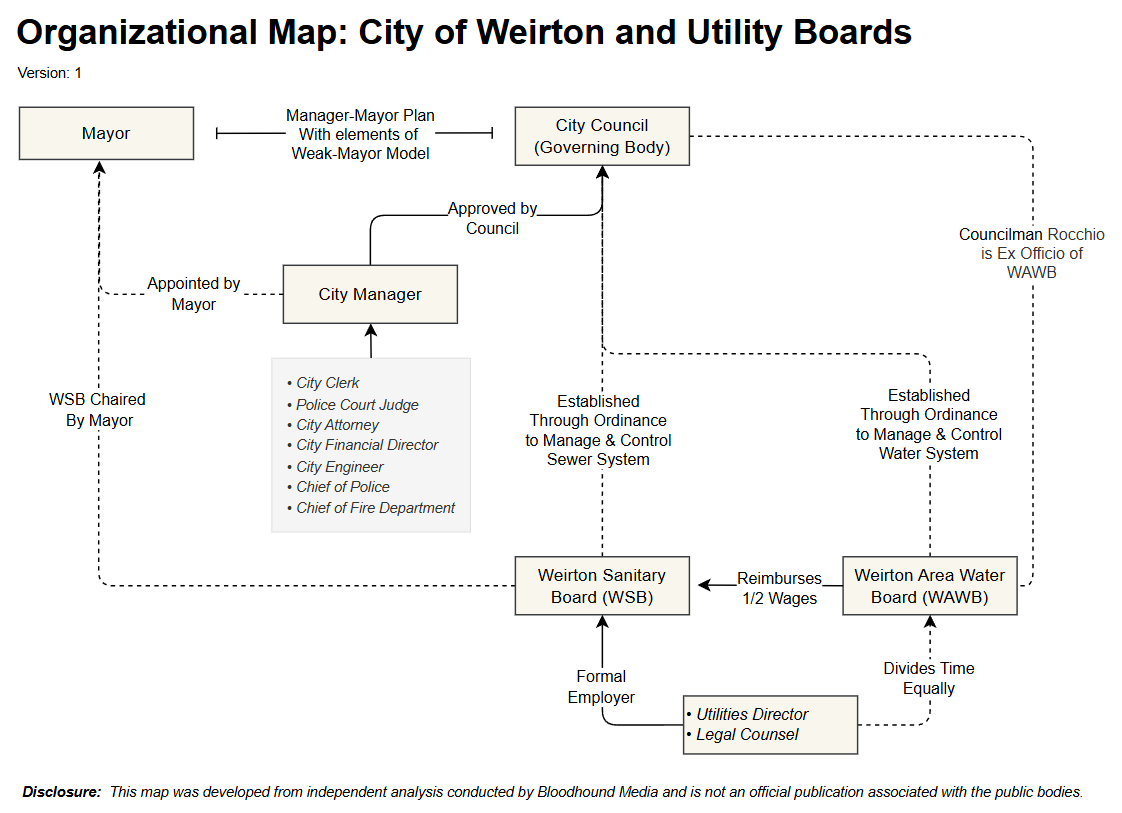
A Blurred Chain of Command
The bureaucratic maze deepens when tracking the reporting structure for the Board’s executive leadership. Without a formal organizational chart or a direct reporting line to the City Manager, accountability becomes a shell game.
Employment records reveal both Utilities Director Amedeo “Butch” Mastrantoni and Legal Counsel Daniel J. Guida are formally employed by the WSB—a body chaired by Mayor Dean Harris. The contracts reflect the employees divide their time equally between the WSB and the WAWB. The WAWB reimburses the WSB for one-half of the employees’ wages on a monthly basis.
Interestingly, the WAWB is not a signatory to these employment contracts. While the contracts reference a separate agreement, a request (FOIA 2026-010) under the West Virginia Freedom of Information Act failed to produce any such document. What kind of “autonomous” body would enter into agreements without a formal contract?
Despite the bureaucratic fog, a subsequent FOIA response (FOIA 2026-011) confirmed there were no records that would legally prohibit or restrict the WAWB’s ability to remove or replace the services of the employees. The authority exists, but it is buried beneath layers of administrative complexity that the average taxpayer has no hope of deciphering.
Conclusion
The Weirton water crisis exposed significant infrastructure vulnerabilities, but it also brought attention to a complex and misunderstood organization structure. The WAWB is often described as autonomous, yet its structure reflects delegated authority within a system that remains anchored to the City. At the same time, key leadership roles operate within a shared employment framework that blurs traditional lines of accountability.
Understanding these distinctions is essential. Clear governance is not simply a matter of structure, but of visibility. Without a well defined understanding of who holds authority, how decisions are made, and where responsibility lies, accountability is not achievable.
NOTE: Mr. Guida’s contract was amended on April 14, 2026 to modify his employment status to an independent contractor. The amendment contains a provision whereby the Weirton Sanitary Board will continue to receive health insurance benefits.